About Us Holy Land Sites Photos Holy Land Tours Christian Community Travel Tips Easter 2012

Tags - herod

September 29, 2010September 29, 2010  0 comments  Encountering Israel

On this mid-March ESRA hike we traveled to the Jordan Valley, close to the country of Jordan. The Jordan Valley is one of a series of valleys making up part of the vast Syrian-African Rift Valley, the gigantic crack in the earth's surface which starts in northern Syria and extends to Mozambique. More than 120 million years old, its most dramatic period of formation was probably in man's prehistoric past, within the last 100 thousand years. The Rift Valley has abundant underground springs (fresh water, salt water, sulfur and hot springs), bizarre land and rock formations, and many earthquakes.


The Jordan Valley is relatively remote for most hikers; it was my first experience of hiking there. A beautiful, fertile (even if very hot) farming area for Israelis and Palestinians, the Jordan Valley has great religious and political significance for Israel. Joshua 3/17: “And the priests that bore the ark of the covenant of the Lord stood firm on dry ground in the midst of the Jordan, while all Israel passed over on dry ground, until all the nation were passed clean over the Jordan.” The Jordan Valley stretches from Lake Kinneret to the Dead Sea and many consider it indispensable for Israel’s defense, essential to ensure security and a necessity in any peace deal.


We started our hike at Ma'aleh haNaarim, at about 700 feet below sea level. Our destination was the Horn of Sartaba, or Alexandrium, as it was known in Hasmonean times. The Hasmonean dynasty was founded by Mattathias the Cohan (the Priest) in 166 BCE. Mattathias was the zealot who dared to start a war against the mighty Seleucid king Antiochus IV Epiphanes. Antiochus was intent on overthrowing the Jewish religion and replacing it with paganism, with himself as a god. Mattathias famously said, after killing the Greek government official who attempted to force him to sacrifice to pagan gods, “Let everyone who has zeal for the Torah and who stands by the covenant follow me!” (1 Maccabees 2/27)


Alexandrium was the fortress built by King Alexander Yannai in honor of his wife, Shalom Tzion, (Greek: Salome Alexandra). He was the son of John Hyrcanus and the great-grandson of Mattathias. Yannai was the first Hasmonean to take the title of King and he was also the High Priest. The sacrilegious mingling of the two roles marked his reign of 27 years, known for Yannai’s violent deeds against the people and his successful military exploits, which expanded the boundaries of the kingdom as far north as the Golan Heights. Yannai’s wife was the widow of his older brother Judah Aristobulus, who ruled for only a year. After Yanni’s death, Shalom Tzion ruled for nine years in her own right before her son Aristobulus became king. Yannai’s son and grandson used the fortress as an armory in their wars against the Romans, who had replaced the Seleucids as the major force in the region. Later, Herod the Great, the Idumean Jew who married the Hasmonean princess Marianme, rebuilt the wrecked fortress and made it his treasury.


However, Herod was a Roman puppet and his reign had absolutely nothing in common with the giants of the Hasmonean clan, Mattathias and his sons Judah the Maccabee (the Hammer), Eleazar, Yohanan, Jonathan, and Simon. Nevertheless, Herod left behind some of Israel’s greatest monuments, including the Western Wall in Jerusalem.


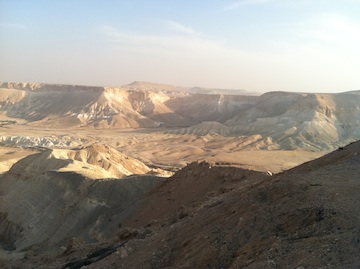
We ascended from Ma'aleh haNaarim rapidly and soon reached the first overlook. Below us was a panorama of rich farm land, military training grounds, the Jordan River (hidden behind a low ridge), and the towering Edomite Mountains of Jordan in the background. After a brief stop to enjoy the view we began a more rigorous ascent of the mountain. On the way our excellent guide Reuven explained how a sophisticated system of aqueducts carried water from the Samarian Mountains to the fortress, using gravity to move the water up the incline. We next stopped by caves which were used as cisterns for the water supply. Even though it was very windy at that spot, Reuven decided that we'd stop and eat lunch there, rather than higher up.


The most difficult part of the hike was the final steep ascent to an altitude of 1,000 ft. On the summit, which had ruins consisting of tumbled boulders, everyone who had additional clothes wore them for protection against the near-gale force winds. The 360 degree view from the peak was fabulous, due to excellent visibility. We could see for miles in every direction, and Reuven named the landmarks we saw. We learned how the Horn of Sarbata was once a vital link in the system of fire beacons which stretched from Shechem in the north to Jericho in the south along the line of mountain ridges. Sarbata was ideally located to signal the new moon and the beginning of the various festivals.


The town Massua (English: torch), far below us in the Jordan Valley, was named in commemoration of this fact. Sarbata was also significant for standing on the boundary between Samaria and Judea. Our time from the summit to the valley floor would have been anticlimactic if not for the incredible sights we enjoyed along the way: folded mountains that looked almost smooth in the distance, sparse displays of winter flowers, a Beduin sheep ranch with nearly a dozen smiling children begging for their picture to be taken. The hike, which took place one day after an extended period of hot, dusty winds, was a great introduction to the trails of the Jordan Valley area.


Steve Kramer is an expert in touring Israel and he also blogs for Travelujah. Order his new book at www.comteqpublishing.com


December 24, 2010December 24, 2010  0 comments  Encountering Israel

Michal and I were about to explore a virtually unknown archeological site dating back 2,000 years, one that is generally inaccessible to tourists. Amit, the young archeologist who has worked for more than a decade on the Herod’s Palace site in Jerusalem, led our group on a recent tour in Jerusalem’s Old City. Our group met at Jaffa Gate, which is easily accessible from the Mamilla pedestrian mall, built on what was “no-man’s land” from 1948-1967. We walked behind David’s Citadel, the venue for Jerusalem’s excellent municipal museum.


After ascending the Old City’s exterior wall via a steep circular staircase - past more antique wall ruins from previous periods - we were on the Ramparts Walk, at the top of the most recent, Ottoman-built, section of the Old City wall. We entered the entrance of a 19th century building, built for use as a “kishle” (the Turkish word for winter barracks) for soldiers in the time of Ottoman rule, which ended during WWI. “Inside, lamps ensure a good view on the vertiginous dig. In the 150 feet long rectangular building, it looks like an impossible ski slope or a place where it is easy to commit a murder, with some gruesome deep pits. The facades are still standing, and the roof has been left undisturbed. The kishle was later used as a prison, by the Turks, British and the Jordanians. On the east side there are barred windows, and on the wall are the prisoners' graffiti in English, Arabic and Hebrew.” (www.bibleinterp.com/articles/schaalje_herodspalace.shtml)) The ruined kishle is only the most recent usage of this venerable location. Josephus ,the Jewish turncoat historian of the 1st century CE, wrote glowingly in “The Wars of the Jews” about the Palace of King Herod (37-4 BCE), which he said bordered on the south side of David’s Citadel.


The palace was constructed on a platform, about 100 feet (from north-south), and 180 feet (from east-west). The Palace consisted of two main buildings, each with its banquet halls, baths, and accommodations for hundreds. It was surrounded with groves of trees, canals, ponds studded with bronze fountains and numerous porticoes where the inhabitants and guests could relax. A “wondrous” walled resort, it had luxurious bedrooms for 100 guests and abundant gold and silver fittings. The gardens were fed by a network of deep canals and underground cisterns that collected rainwater. The water taps were enclosed copper statues. (This luxurious complex was only one of several palaces Herod built for himself.)


We learned that earlier excavations outside the city walls during the 1970s had uncovered the exit of a water drain belonging to Herod’s palace. The drain transported water and sewage from the palace into the Hinnom valley. The other end of the drain was dug up in excavations at the kishle. The pipe is big enough for humans to creep through. It was probably used for that purpose during the First Jewish War, when Jewish rebels fled the city via the sewers of Herod’s Palace. Around 70 CE, the Roman general Titus (later Emperor Titus) set up the Tenth Legion’s camp in the Palace sector. Titus destroyed the Temple, expelled the Jews from the city and renamed it Aeolia Capitola. The Palace was a Roman stronghold, from which Rome controlled Israel for 200 years. It was eventually destroyed by Jewish rebels during their revolt against Roman rule. Standing at a substantial depth below the prison floor, we observed the remains of eight pools which had once been used as dye vats. It was thrilling to see an original Hasmonean city wall, dating to the 3rd century BCE. After the 7th century CE Arab conquest, Mohammed Ali from Egypt took over the walled city.


Against the eastern wall, Crusader arches are visible. In the western wall, there is evidence that the Crusaders fortified and heightened the 15-foot thick Hasmonean wall, which was a common practice. There is an even older wall from King Hezkiyahu’s era, which was around 700 BCE. He built the Siloam Tunnel in the nearby City of David, a 1,500-foot-long-tunnel dug to protect Jerusalem’s water source, the Gihon Spring, from the invading Assyrians (2 Chronicles. 32:2-4). The most astounding finding on the site is a late-Israelite wall from the period of the kings who followed David and Solomon, dating from before 587 BCE! This wall lies well inside the Herodian and earlier Hasmonean walls of the Palace. The stones are a lot smaller than those in the Herodian wall, but they still stand fast. Further excavation at this richly historical site is unlikely because of a lack of funds.


An additional impediment to developing the site is that it is constrained by the Old City police station in one direction and David’s Citadel in the other. We ended our tour next to the site on Mt. Zion. On our way back to Jaffa Gate, we enjoyed the fantastic view across the Hinnom Valley to west Jerusalem. We passed the axle for a thin cable stretching across the narrow valley, which allowed Jewish soldiers occupying a stronghold on Mt. Zion to be supplied during the War of Independence. Israel lost control of the Old City to the Jordanians during this war and Jews were prohibited from visiting the Old City and its religious sites for nineteen years. Jerusalem was reunited when Israel was victorious in the Six Day War of 1967, allowing people of all faiths to visit the highly significant ancient city. Today it’s possible for a group like ours to enjoy historical sites throughout Jerusalem.


Steve Kramer is an expert in touring Israel and he also blogs for Travelujah. See his new book at www.encounteringisrael.com. People can learn, plan and share their Holy Land tour and travel experiences on Travelujah.


Search The Site.

Share This Page

Bookmark and Share

Description

Kramer
Posts: 12
Comments: 2
TOURING AND TREKKING THROUGHOUT ISRAEL by Steve Kramer, author of "ENCOUNTERING ISRAEL - GEOGRAPHY, HISTORY, CULTURE" published by ComteQ Publshing (www.comteqpublishing.com) See Steve's weekly opinion articles at www.jewishtimes-sj.com/current/column

Categories

Tags

2 tel aviv (2)
2 herod (2)
1 canaan (1)
1 gath (1)
1 jerusalem (1)
1 old city (1)
1 tel tzavit (1)
1 cyprus (1)
1 atlit (1)
1 hatikva (1)
1 aliya bet (1)
1 art glass (1)
1 maimonides (1)
1 rambam (1)
1 shamna (1)
1 olive oil (1)
1 boutique (1)
1 mysticism (1)
Search The Bible

Produced by KCS interactive boutique
Copyright © 2011 Travelujah.com